The boots people bring back.
The heels are worn down. The leather has your crease in it. When you bring a pair back, the question we love to hear is how much of it we can keep. That’s the kind of boot Stewart set out to make in 1940.
Our history
A boot built around a foot
Ronny Stewart had a background in orthotics. He went into partnership with Romero Boot Company and brought that eye for fit to Western boots. A person could choose a handsome toe and still need room behind it. The maker had to see both.
A pattern worth keeping
Ronny drew the 0124, a plain Western boot. Decades later, when Victor’s shop worked with Kindred Black, they were still making it from that design. Some things earn their place on the bench by quietly getting it right the first time.
Tucson becomes home
Stewart had a shop on Temple Street in Los Angeles before settling in Tucson. Around that time James Dean asked for a little more height for Giant. Stewart made him a special heel. It was a bit of film work done well below eye level.
Victor Borg takes the bench
Victor Borg took over and kept looking at how a person moved in their boots. He took uneven heel wear seriously. The way a heel wears down can tell you something a tape measure misses.
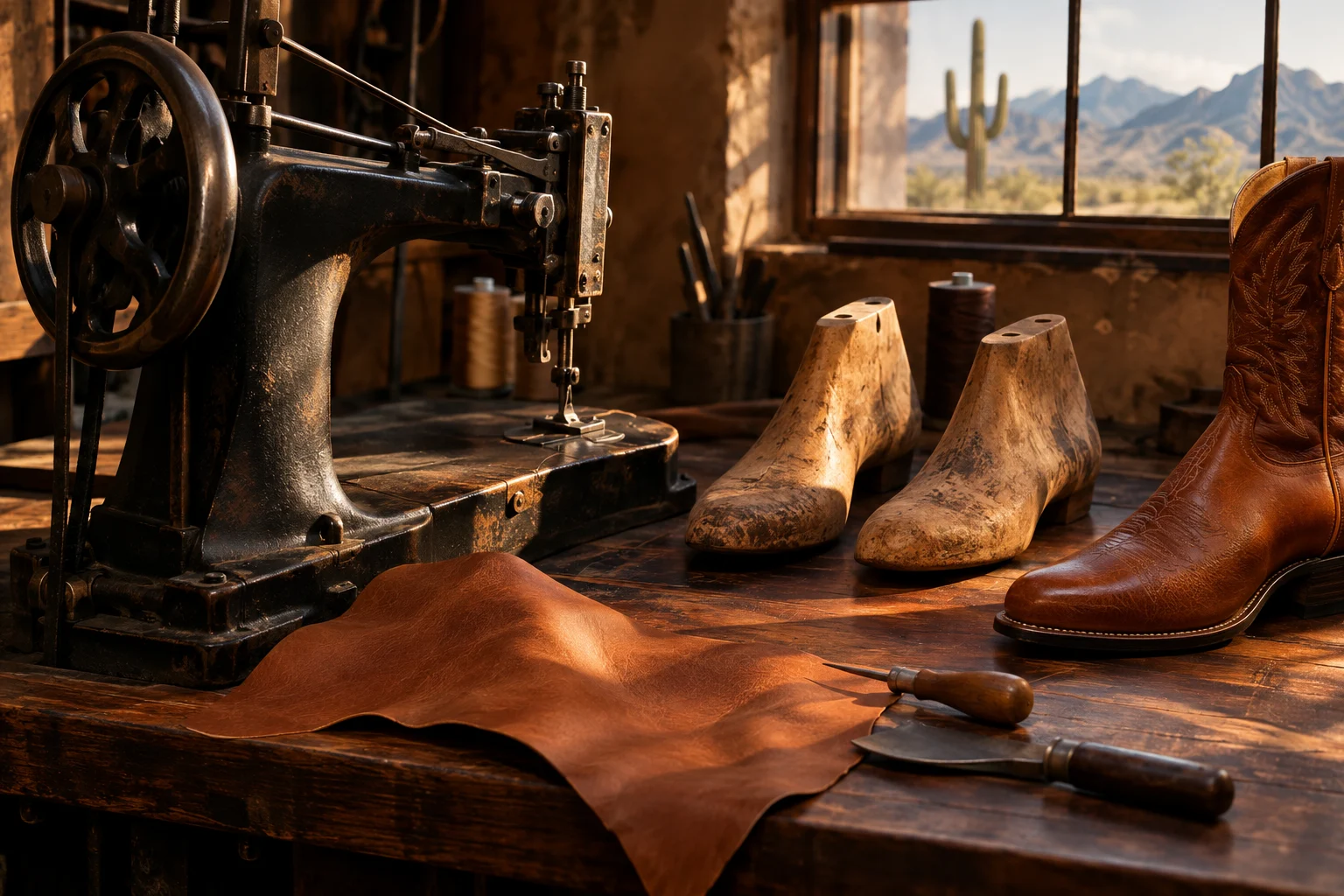
A good eye takes years to pass on.
Today Nat Garcia runs Stewart. Victor still teaches and advises. An apprentice can see a finished boot in a photograph. It takes someone at the bench to point out the little rise under the toe, turn the boot, and show them what to look for from the other side.
What we stand for
Your day is part of the fit.
Bring the pair you wear most. Tell us what you wore it to do and when it began to rub. At a bespoke fitting, we watch you walk before taking 44 measurements. We want to know the person who’ll put those miles on the boots.
A new heel. The pair you know.
A worn heel may be ready for retirement while the rest of the boot is in its prime. Bring it back and we’ll look at what we can clean, mend or replace. You’ve put years into that leather. That counts for something at this bench.
Give good tools a job.
A vintage stitcher does work worth keeping. A better way to record a fit can help the next time you come in. Every tool earns its place by helping the maker make a better boot or helping you understand your fit.
Where we draw the line
Your little toe gets a vote.
It can have a surprising amount to say by the end of the day. If a bespoke boot pinches, rubs or slips at your fitting, it goes back to the bench. We keep working on it until the fit is right.
The last look is part of the job.
The maker checks the stitching, sights the heel and looks at the rise under each toe. If something is off, the pair stays at the bench. If that takes longer, you deserve to hear it from us.
Take the answer home with you.
Ask what the work will cost, how long it may take and what we can do for your feet. We’ll give you an honest answer and time to make up your mind. Your fitting is a good place for questions, even the small ones.
Visit the Tucson workshop
The one with the worn heel will do nicely. There’s a lot it can tell us the first time you come to Tucson.
+1-520-622-2706stwboot50@gmail.comBook a Tucson fitting